

High‑capacity BACnet and Modbus routing for enterprise‑scale building automation networks
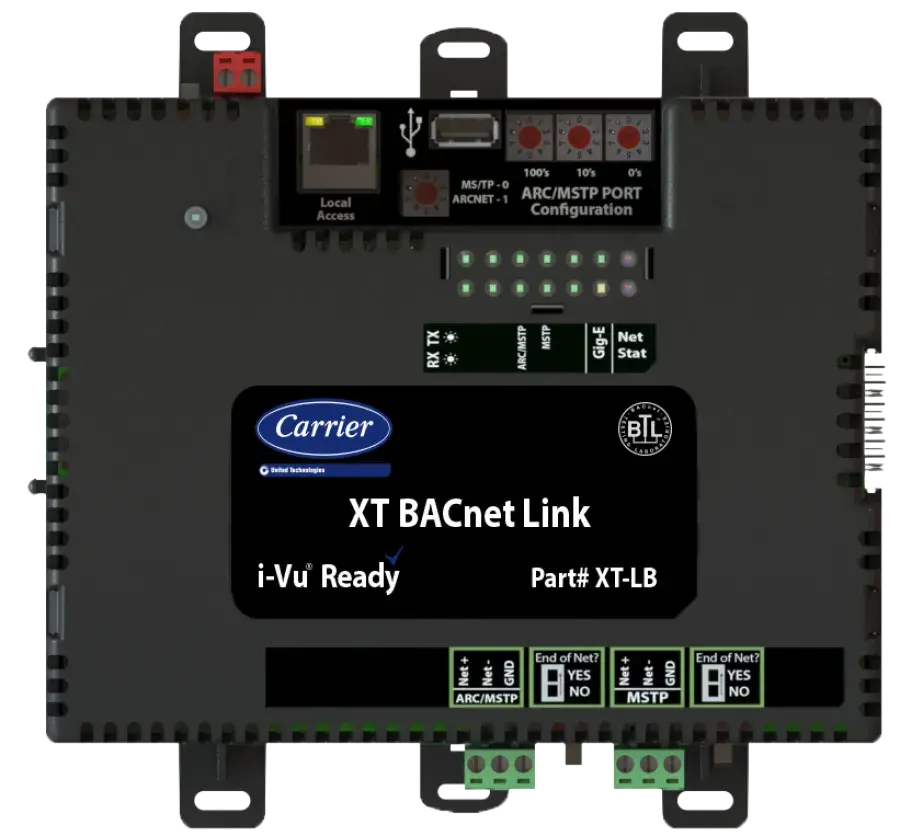
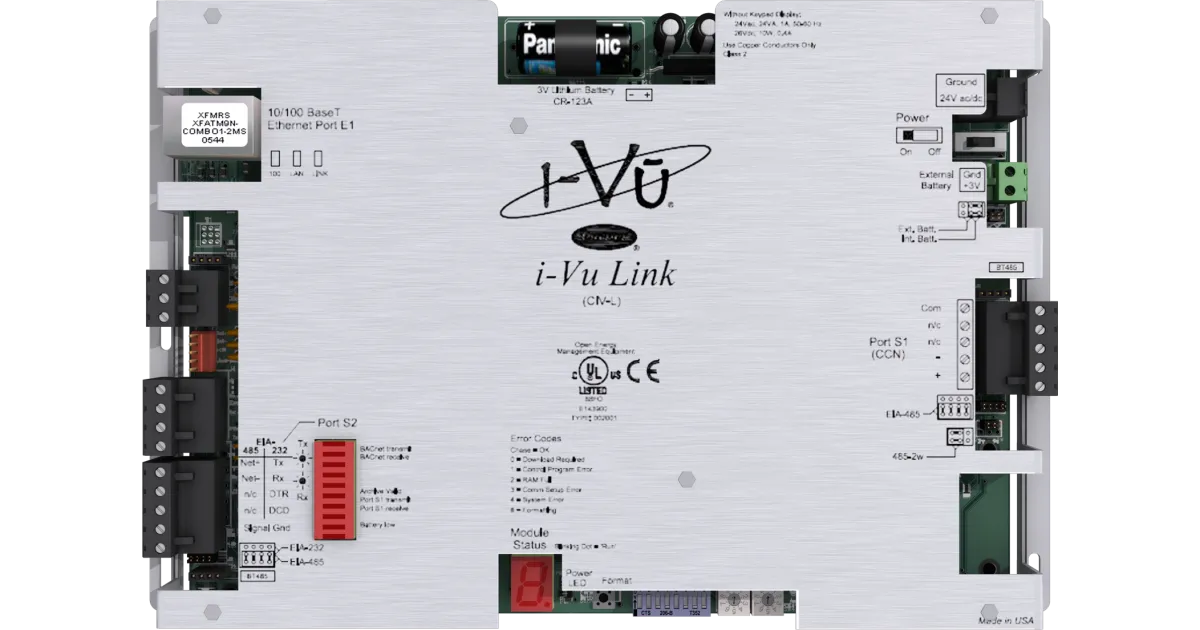
The i‑Vu® XT BACnet® Link (XT‑LB) delivers robust BACnet routing, BBMD functionality, and large‑scale third‑party integration, enabling seamless connectivity across IP, MS/TP, ARCnet, and Modbus networks within the Carrier i‑Vu® Building Automation System.
Network & Integration Device
The i-Vu® XT BACnet link allows you to integrate other manufacturers’ equipment into the i-Vu® building automation system using the BACnet protocol, making it easy to tie in equipment such as VFDs, boilers, and lighting systems. Each i-Vu® XT BACnet link supports up to 1,500 third party BACnet points.
The i-Vu® XT BACnet link also routes BACnet messages between the i-Vu® building automation system backbone (BACnet/IP), and a subnetwork of i-Vu® controllers (BACnet MS/TP and/or BACnet ARCnet). It connects directly to the Ethernet LAN and provides the i-Vu® web server with access to the entire i-Vu system.
The i-Vu® XT BACnet link also extends an i-Vu® system, allowing individual BACnet MS/TP networks (with up to 60 controllers each), and BACnet ARCnet networks (with up to 99 controllers each), to be connected together via the i-Vu® building automation system backbone.
BACnet Building Controller (B‑BC), BACnet Router (B‑RTR), and BACnet BBMD (B‑BBMD)
(BACnet 135‑2012 Annex L, Protocol Revision 14)
Gigabit Ethernet (BACnet/IP, BACnet/Ethernet, Modbus/IP)
Two EIA‑485 ports for BACnet MS/TP or Modbus RTU
Local access Ethernet port for startup and troubleshooting
Up to 1,500 BACnet points
Up to 500 Modbus points
Up to 999 control programs (memory dependent)
24 VAC ±10% (50 VA) or 26 VDC ±10% (15 W), Class 2 power
It provides high‑capacity routing and integration between BACnet and Modbus networks in large building automation systems.
Yes. FDR support simplifies integration of third‑party BACnet devices across networks.
Yes. Its high point capacity and routing capabilities make it ideal for enterprise and campus‑scale deployments.
Yes. A battery‑backed real‑time clock maintains time and operational continuity during outages.